
About Medicine
Somatropin, or human growth hormone, is a peptide hormone produced by somatotroph cells of the anterior pituitary gland. Growth hormone secretion varies throughout life, with higher levels during childhood and adolescence and a gradual decline during adulthood. Its secretion is pulsatile and reaches peak levels during the night, shortly after the onset of deep sleep.
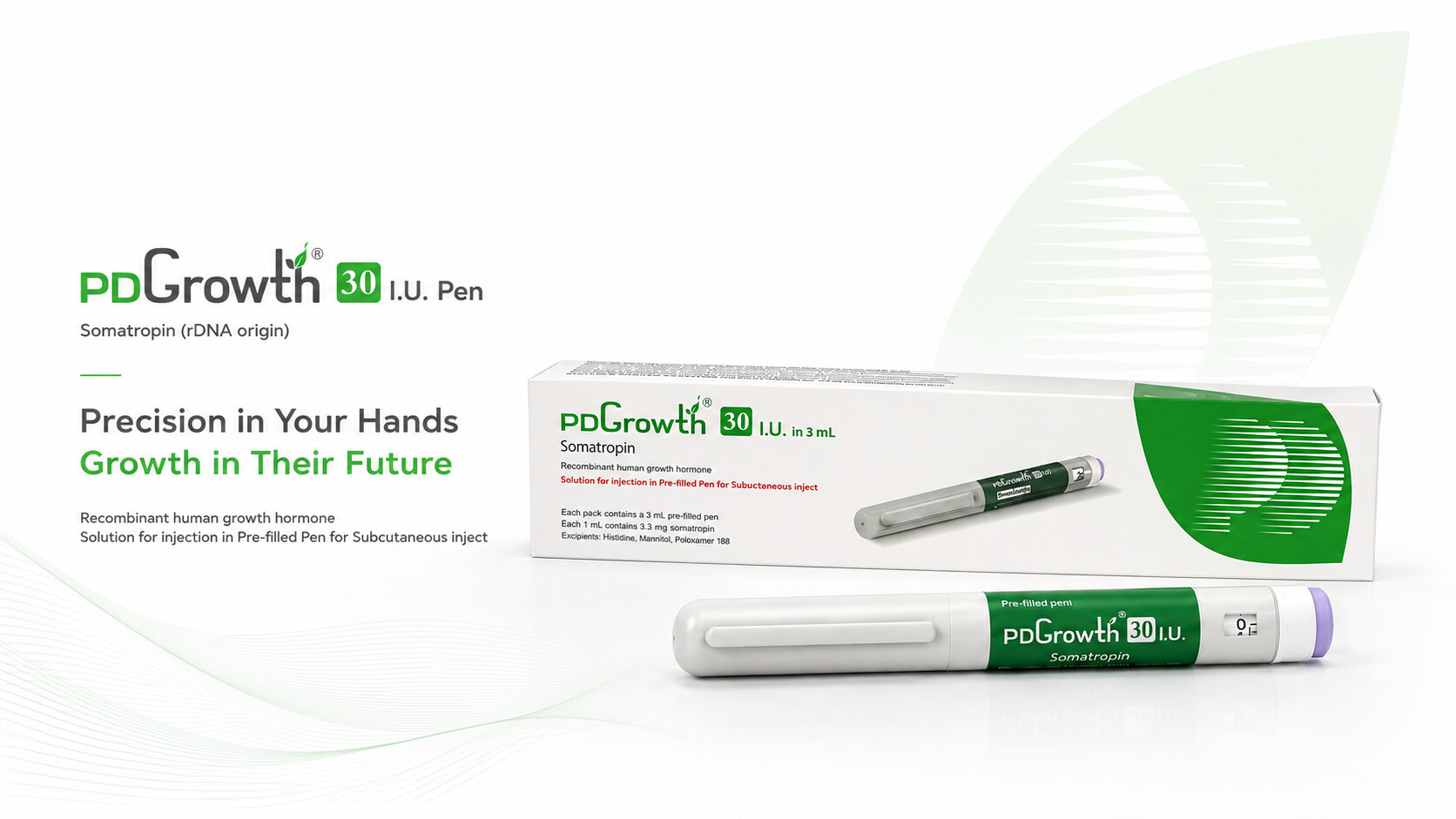
PDgrowth® Pre-filled PEN contains somatropin, a recombinant human growth hormone with an amino acid sequence identical to natural human growth hormone. Somatropin is a non-glycosylated polypeptide consisting of 191 amino acids, with a molecular weight of approximately 22,124 Da and two disulfide bonds. It is produced using recombinant DNA technology.
Pharmaceutical form
– Solution for injection: Sterile – Clear – Colorless – Free from visible particles
– Supplied in a pre-filled pen
– Available strength: Somatropin 30 IU/3 mL, equivalent to 10 mg
– Pack size: one pre-filled pen
Qualitative Composition
– Active substance: Somatropin
– Excipients: Mannitol, Histidine, Poloxamer 188, Phenol, Sodium hydroxide, Hydrochloric acid, Water for injection
Guidance to patients
PDgrowth® Pre-filled Pen is intended for subcutaneous administration. The product should be used according to the physician’s prescription and after appropriate instruction by healthcare professionals.
A new disposable needle should be used for each injection. The recommended needle size is 29G to 32G with a length of 6 mm. The pen and needle must not be shared.
The pen should be inspected before use and must not be used if damaged, or if the solution is cloudy, discolored, or contains visible particles.
For each new pen, the medicine flow should be checked before first use. The prescribed dose should be selected according to the physician’s instruction and the product-specific dose conversion table.
Somatropin-containing products have no known effect on the ability to drive or operate machinery.
In case of overdose or missed dose, the patient should seek medical advice. A double dose should not be administered to compensate for a missed dose.
Use
PDgrowth® is used in pediatric patients for the treatment of growth disorders associated with:
-
Absent or severely reduced growth hormone production.
-
Turner syndrome.
-
Reduced kidney function.
-
Short stature in children born small for gestational age.
-
Noonan syndrome.
In adults, PDgrowth® is used as growth hormone replacement therapy in patients with growth hormone deficiency that has continued from childhood or developed during adulthood due to tumors, tumor treatment, or diseases affecting the gland responsible for growth hormone production.
-
Dosage and administration
The dose should be determined by the treating physician and individualized according to body weight, body surface area, height, sex, clinical response, tolerability, and serum IGF-1 concentration, where appropriate.
PDgrowth® should be administered by subcutaneous injection once daily, preferably at night before bedtime, unless otherwise prescribed by the physician.
Recommended pediatric dose ranges include:
– Growth hormone deficiency: 0.025–0.035 mg/kg/day or 0.7–1.0 mg/m²/day
– Turner syndrome: 0.045–0.067 mg/kg/day or 1.3–2.0 mg/m²/day
– Chronic kidney disease: 0.050 mg/kg/day or 1.4 mg/m²/day
– Small for gestational age: 0.035 mg/kg/day or 1.0 mg/m²/day
– Noonan syndrome: 0.066 mg/kg/day; in some patients, 0.033 mg/kg/day may be sufficient
In adults with growth hormone deficiency continuing from childhood, the recommended starting dose is generally 0.2–0.5 mg/day, followed by dose adjustment according to clinical response and serum IGF-1 concentration.
In adult-onset growth hormone deficiency, treatment is usually initiated at a lower dose, typically 0.1–0.3 mg/day, and gradually increased at monthly intervals according to clinical response and adverse reactions. Serum IGF-1 may be used as a guide for dose adjustment.
Women, particularly those receiving oral estrogen therapy, may require higher doses than men. Dose requirements generally decrease with age. Maintenance doses vary between patients but rarely exceed 1.0 mg/day.
Treatment should not be discontinued without medical advice.
Contraindications
PDgrowth® Pre-filled Pen should not be used in the following conditions:
-
Hypersensitivity to somatropin, phenol, or any excipient of the product.
-
Kidney transplantation.
-
Active tumor or cancer; treatment should be initiated only after the tumor is inactive and anti-tumor therapy has been completed.
-
Acute critical illness, such as complications following open-heart surgery, abdominal surgery, multiple accidental trauma, or acute respiratory failure.
-
Closed epiphyses in patients without growth hormone deficiency.
-
Warning and Precautions
Before initiating PDgrowth® therapy, caution is required in patients with diabetes, previous malignancy or tumor, recurrent headache, visual disturbance, nausea or vomiting, abnormal thyroid function, kidney disease, scoliosis, limping, or concomitant glucocorticoid replacement therapy.
Scoliosis may progress during periods of rapid growth; therefore, patients should be monitored during treatment. New-onset limping or hip/knee pain should be evaluated promptly.
Thyroid function and kidney function may require regular monitoring. Patients receiving glucocorticoid replacement therapy may require dose adjustment.
PDgrowth® may be associated with pancreatitis. Severe abdominal or back pain should be evaluated promptly.
Clinical experience is limited in patients older than 60 years and in adults treated with somatropin for more than 5 years.
Pregnancy and breast-feeding
Somatropin-containing products are not recommended in women of childbearing potential who are not using effective contraception.
If pregnancy occurs during treatment, treatment should be discontinued and the physician should be informed immediately.
PDgrowth® should not be used during breast-feeding, as somatropin may pass into breast milk.
Side Effects
Like all medicines, PDgrowth® may cause adverse reactions, although not all patients experience them.
Adverse reactions reported in children and adults include hypersensitivity reactions, symptoms suggestive of increased intracranial pressure such as headache, visual disturbances, nausea or vomiting, reduced serum thyroxine, and hyperglycemia. Anti-somatropin antibody formation, increased liver enzymes, leukemia, and recurrence of brain tumors have also been reported; however, no causal relationship with somatropin has been established.
In children, reported adverse reactions include injection-site reactions, gynecomastia, rash, muscle or joint pain, peripheral edema, hip or knee pain, and limping. In patients with Turner syndrome, increased growth of hands and feet relative to height and a higher risk of ear infections with high-dose somatropin have been reported.
In adults, reported adverse reactions include peripheral edema, headache, paresthesia, joint pain or stiffness, myalgia, type 2 diabetes mellitus, carpal tunnel syndrome, pruritus, injection-site pain, muscle stiffness, and gynecomastia.
Drug Interactions
Dose adjustment or monitoring may be required when PDgrowth® is used concomitantly with glucocorticoids, cyclosporine, insulin, thyroid hormones, gonadotropins, anticonvulsants, oral estrogen, or other sex hormones.
Monitoring
During treatment with PDgrowth®, monitoring may include growth response, serum IGF-1, thyroid function, blood glucose, symptoms of intracranial hypertension, scoliosis progression, hip or knee pain, renal function, tumor recurrence, and adverse reactions.
Mechanism of action
Somatropin acts by binding to growth hormone receptors on target cells and activating intracellular signaling pathways. Many of its growth-promoting and anabolic effects are mediated through IGF-1, which is produced in response to growth hormone receptor activation.
Somatropin stimulates linear and skeletal growth in children and contributes to protein synthesis, lipolysis, and metabolic regulation.
Preparation and injection
PDgrowth® Pre-filled Pen is administered by subcutaneous injection.
Before use, the pen should be removed from the refrigerator and allowed to reach room temperature. Hands should be washed thoroughly. The pen and medicine chamber should be inspected before administration. The product should not be used if the pen is cracked or damaged, or if visible particles are present in the solution.
A new disposable needle should be attached straight onto the pen and tightened securely. The outer needle cap should be kept for needle removal, and the inner needle cap should be discarded.
For a new pen, the medicine flow should be checked before injection. For a pen already in use, priming should be performed after attaching a new needle according to the instructions for use.
The dose selector should be turned until the prescribed dose is aligned with the pointer. If an incorrect dose is selected, the selector may be turned forward or backward until the correct dose is shown. The injection button should not be pressed while adjusting the dose.
After injection, the needle should be removed carefully and discarded safely. The pen cap should be replaced after each use. The pen should be stored without the needle attached.
The injection site should be changed at each administration to reduce the risk of local tissue changes
Storage
Before first use, store the unused pen in a refrigerator at 2°C–8°C. Do not freeze.
After first use, the pen may be stored for up to one month at 2°C–8°C or for up to three weeks at room temperature below 25°C. After this period, the pen should be discarded.
Replace the pen cap after each use. Keep the product in the original package to protect it from light. Do not expose the pen to direct sunlight, heat sources, or warm water to bring it to room temperature.
Do not use after the expiry date printed on the carton and pen label.
Do not attempt to open or repair the pen. Keep the pen away from dust and liquids. The pen may be cleaned with a cloth dampened with mild detergent. Do not wash, soak, or lubricate the pen.
Do not share the pen or needle. Keep out of the sight and reach of children.